


A Sunday in Paris
Actualitzat: 7 days ago
The thousands of visitors who flock to Paris every day fill the Champs-Élysées, the Louvre, the Eiffel Tower, Montmartre and countless other tourist attractions, not to mention a few theme-park castles made of papier-mâché. The Château de Vincennes, by contrast, is a place where you can enjoy nearly a thousand years of history in relative peace and quiet. And if you are a classic car enthusiast, there is an added attraction: on the first Sunday of every month, the grounds host a wonderful gathering of anciennes voitures.
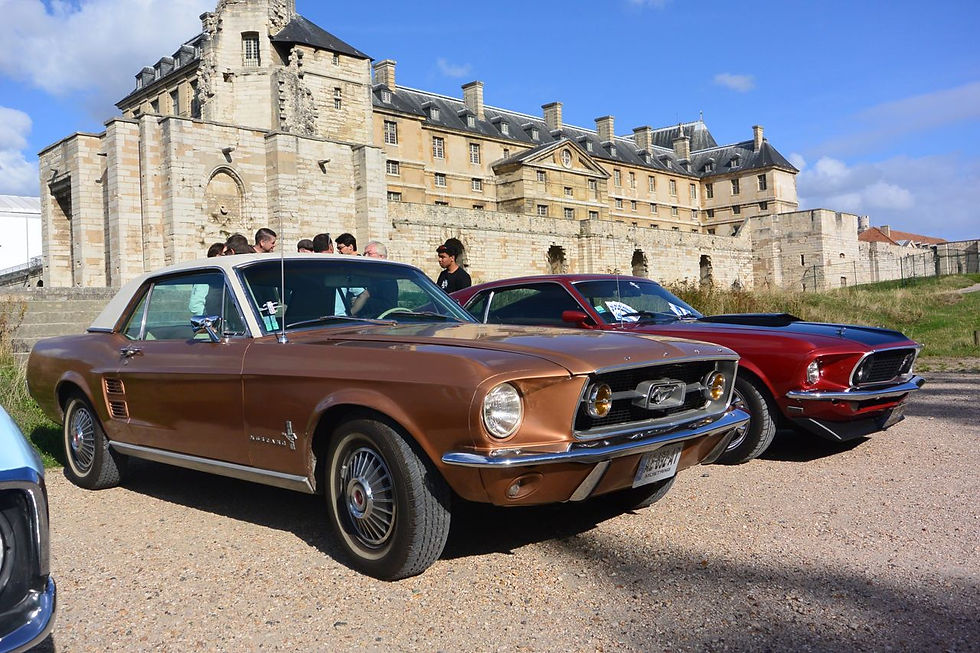

The château is remarkably well preserved. The moat is no longer filled with water, but its walls still encircle the entire site. What began as a hunting lodge in the 12th century eventually became a military fortress and later a royal residence. In 1964, even General de Gaulle considered moving the presidential residence here. Several expeditions set off from Vincennes during the Crusades, and the château has undergone numerous transformations over the centuries. Since the 14th century, however, its most distinctive feature has been the imposing keep that dominates the inner courtyard, where the Crown of Thorns was once kept, or so the story goes. In the 18th century, the château became a prison, housing inmates such as the Marquis de Sade, several Enlightenment encyclopaedists and revolutionaries. Later, Mata Hari was executed by firing squad within its walls.
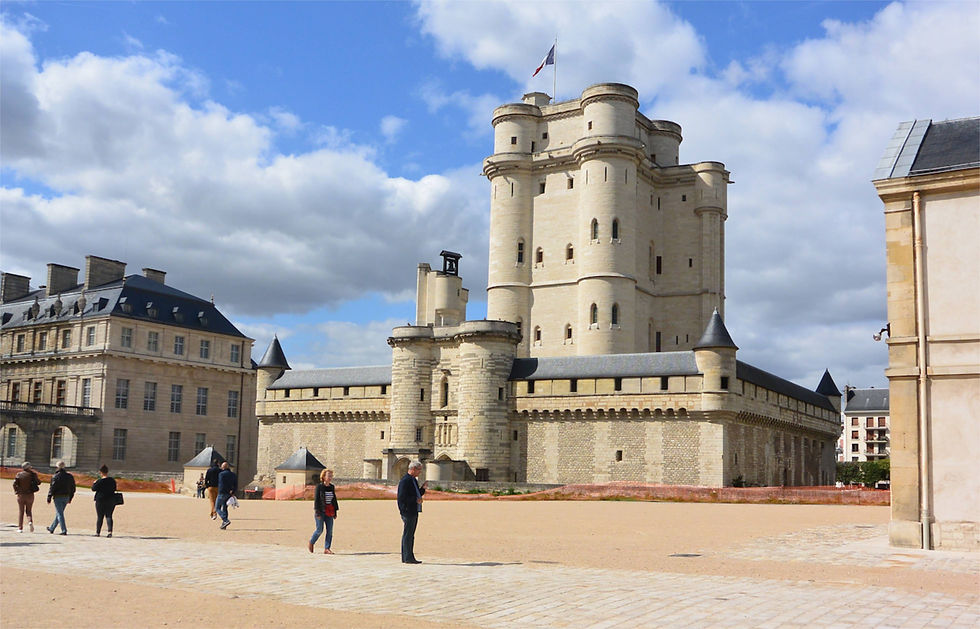
Today, with a Metro station right outside the gates, the château remains one of the main gateways to the Bois de Vincennes, where visitors can enjoy a stroll, hire a bicycle or visit the city's zoo. If you are feeling energetic, you can even get there from the city centre via the Promenade Plantée, a greenway that begins near the Bastille and follows a disused railway line, raised above the streets on iron bridges, all the way to the outskirts of the park.
For classic car enthusiasts, Vincennes is also the meeting point for the monthly gathering organised by the Vincennes en Anciennes club. Although the area is generally peaceful during the week, Sundays bring a very different atmosphere, with cyclists, runners and countless groups taking part in sporting, cultural and leisure activities. If you want to enjoy the classics before the crowds arrive, an early start is essential.

Around two hundred cars usually turn up, most of them in immaculate condition. What I particularly like about this gathering is the sheer variety. Of course, there are the usual Minis, MGs, Beetles and other familiar sights that you come across at classic car meets everywhere. But you can also find cars from the 1920s, Italian sports cars from the 1950s and 1960s, post-war French models, American muscle cars and enormous Detroit saloons, as well as motorcycles, vans and much more.
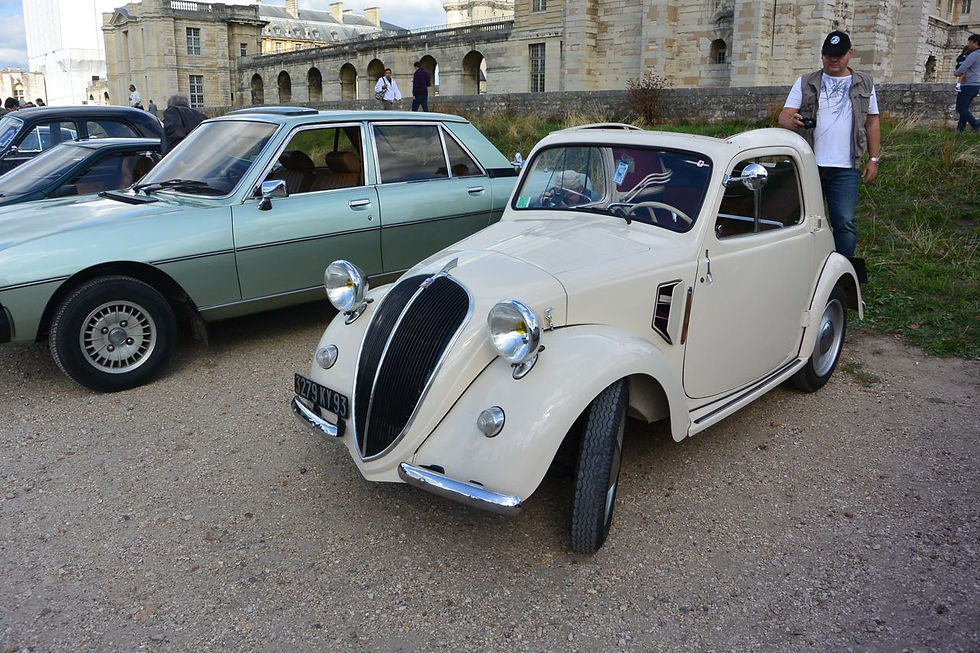
Autobianchi A111: A Fiat in Disguise?
I'll start with the Autobianchi A111, a relatively little-known car that nevertheless played an important role in the development of the Italian motor industry.
At first glance, its styling and proportions make it look like a restyled FIAT 124, the second most-produced car in the world over a period of almost fifty years. In fact, the Autobianchi revived the FIAT 123 project, which the Turin-based company had abandoned in favour of the rear-wheel-drive Fiat 124.


The A111 used the platform of its predecessor, the Autobianchi Primula, and continued the Fiat Group's experiments with front-wheel drive. Although it never achieved the sales success of the Primula, the A111 helped pave the way for Fiat's eventual adoption of front-wheel drive in the 127 and 128.
With its square headlamps and integrated rear light clusters, the Autobianchi looks more modern than the early FIAT 124s, although the two cars are remarkably similar in appearance. I haven't been able to verify this, but I would not be surprised if even the windscreen were shared.
The main difference between the two cars is a typical consequence of their different drivetrains: the distance between the front wheel arch and the front door is greater on the FIAT 124. Its longitudinally mounted engine and gearbox positioned behind it required a different layout from the Autobianchi's front-wheel-drive configuration.
The car at Vincennes belongs to the second series, introduced in 1970. The easiest way to distinguish it from the original version is by its twin rear light clusters.

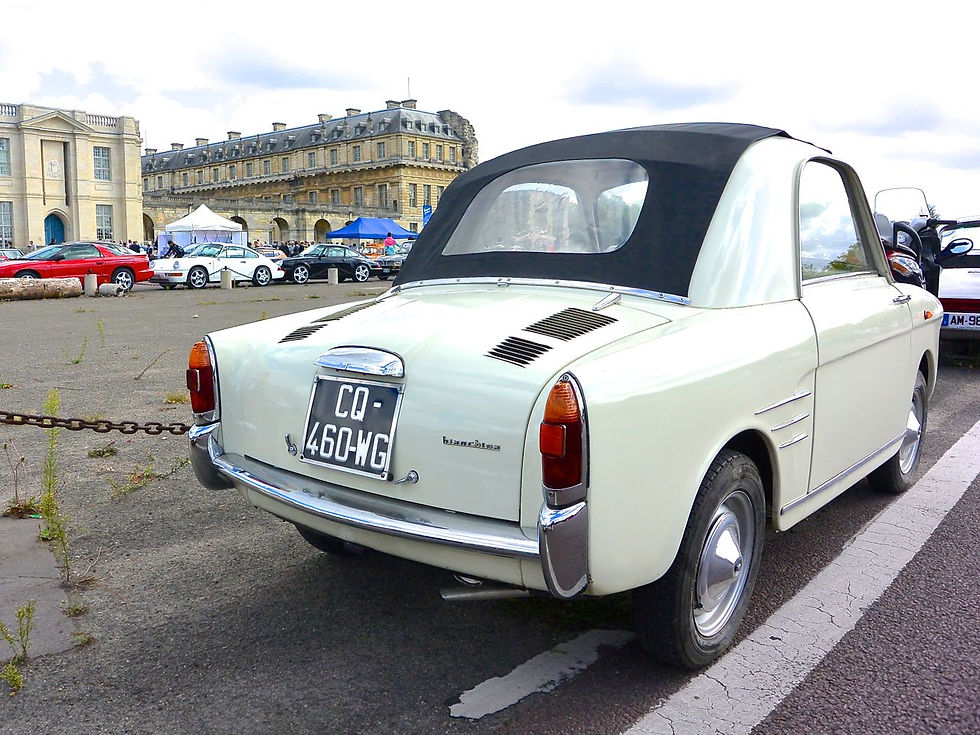
Autobianchi Bianchina: Little Car, Big Ambitions
The Autobianchi Bianchina was something of an upmarket version of the Fiat 500, sharing its chassis while benefiting from a more powerful version of the same basic mechanical package.
Its more elaborate styling, with the proportions of a miniature saloon, evokes the Italian convertibles of the 1950s. The Bianchina that turned up at Vincennes that morning was the Trasformabile, the first version to be introduced. The Desio-based manufacturer later expanded the range with a cabriolet, an estate version known as the Panoramica, a four-seat saloon and even a van.
More than 300,000 Bianchinas were produced in total, most of them sold in Italy.


Vespa 400: A Microcar with a French Connection
Another Italian microcar at Vincennes was the Vespa 400. Curiously, Piaggio's tiny automobile was never manufactured or marketed in Italy; instead, it was built in France.
This unusual arrangement was also linked to the FIAT 500. Piaggio's management was apparently unwilling to challenge the powerful Agnelli family by introducing a direct competitor to its little two-cylinder Fiat in the Italian market.
Piaggio already had a strong position in the scooter business, and its microcar shared much of the same philosophy. Powered by a tiny two-cylinder, two-stroke engine producing barely 14 bhp, the Vespa 400 could reach a top speed of just over 80 km/h (50 mph).
Its styling is reminiscent of the Bianchina, although the latter looks decidedly larger when the two cars are parked side by side. The Vespa's cheerful colour palette reinforces its resemblance to Piaggio's scooters.
Another curious detail is that the Vespa 400's body pressings were subcontracted to the very same facilities where the Facel Vega was manufactured. Despite the hopes invested in it, the little car never achieved the commercial success anticipated, and production ended in 1961. Today, it is one of the more sought-after microcars among collectors.
There were plenty of other fascinating classics at Vincennes that day, and I could write about some of them in future posts. In the meantime, if you happen to be in Paris over a weekend and it is the first Sunday of the month, you now know about another attraction worth adding to your itinerary. It might just be one of the most enjoyable ways to spend a Sunday morning in Paris.


Comentaris