


Microcars at the Louwman Museum
Actualitzat: Oct 27
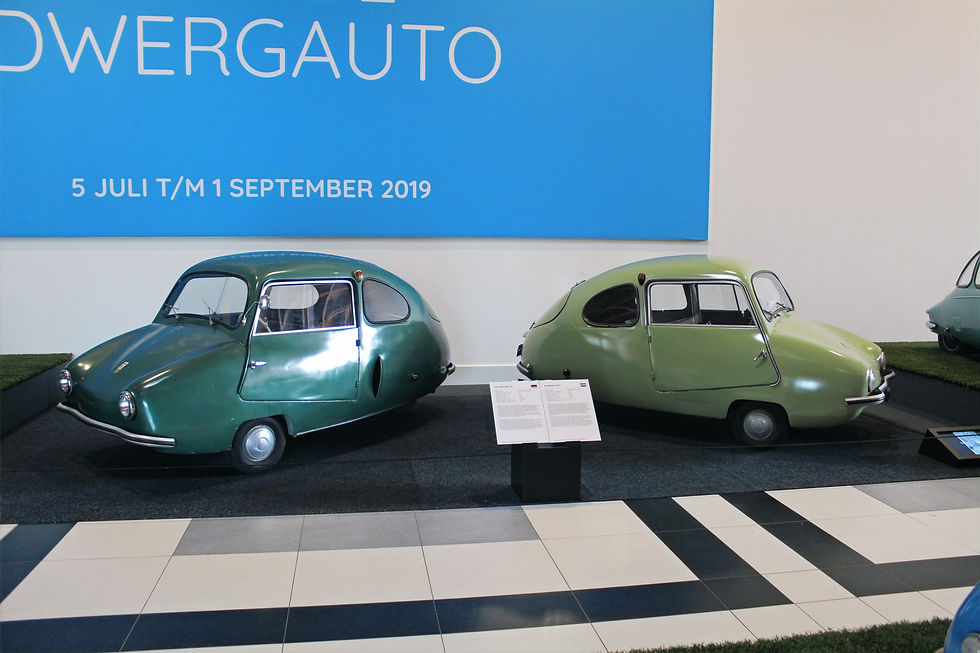
Among the many disastrous consequences of the devastation wrought by the Second World War was the collapse of Europe's motor industry. Material shortages, the destruction of production facilities and a lack of purchasing power characterised the post-war period, during which a large proportion of Europe's car fleet had disappeared. Although some new models appeared towards the end of the war, such as the Renault 4CV in France, most production consisted of pre-war designs, and only a privileged few could afford to buy a car. In the early 1950s, numerous companies in various countries embarked on the production of microcars: small vehicles usually powered by motorbike engines. Often featuring rather curious designs, these contraptions were intended as a means of transport for people who could not afford a conventional car but were not content with a motorbike either.
As a temporary addition to its excellent car collection, the Louwman Museum in The Hague hosted an interesting exhibition of microcars from various European manufacturers from 5 July to 1 September. Around thirty examples from different countries on both sides of the Iron Curtain welcomed visitors to this showcase of Europe's automotive diversity during the Cold War.
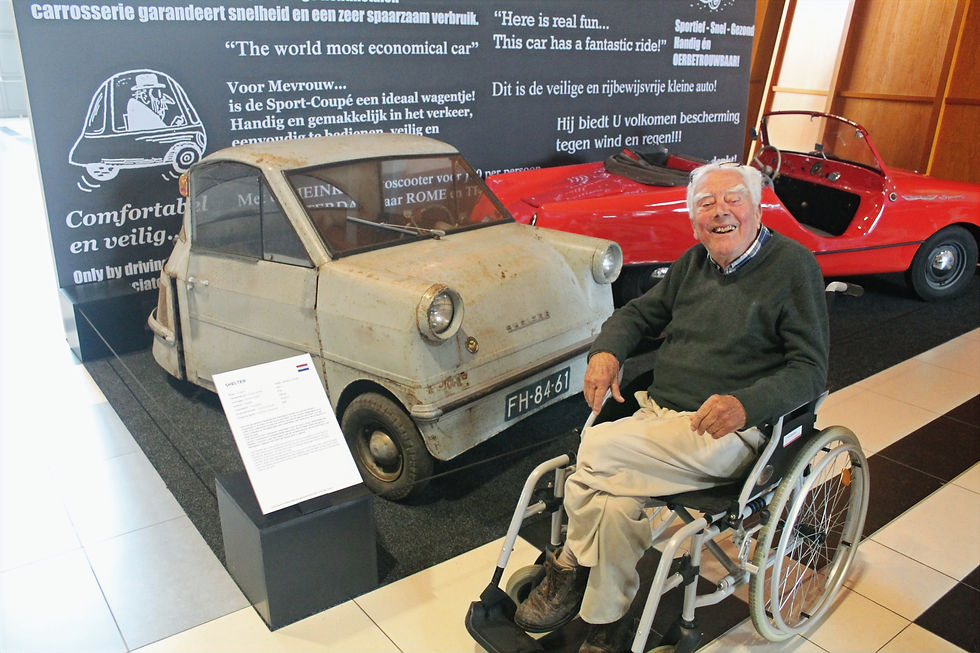
While in The Hague, Dutch products were a must-see. Among them, one microcar dating from 1958 stood out. It was designed by Arnold van der Goot, then a young aeronautical engineer, who also manufactured the parts required to build twenty units. This small, single-cylinder, two-stroke car is little bigger than a wheelchair fitted with a body. Unfortunately, the arrival of the DAF 600 on the market that same year had the same effect on Dutch microcars as the SEAT 600 had in Spain: these models became virtually unsellable. Arnold van der Goot himself attended the exhibition, proudly posing alongside his creation.

The Bambino 200 enjoyed greater success in the Netherlands. Featuring a fibreglass body shaped like a drop of water, it was manufactured between 1955 and 1957. Like the Chilean ‘Nobel’, which can be seen at the Lira Museum in Santiago, the Bambino 200 was a licensed copy of the German Fuldamobil, an example of which was displayed alongside it in the same exhibition. A convertible prototype of the Bambino 200, the 200 Sport, was built and unveiled at the 1957 Amsterdam Motor Show. This unique example, on loan from a museum in the United States, was also among the vehicles on display.
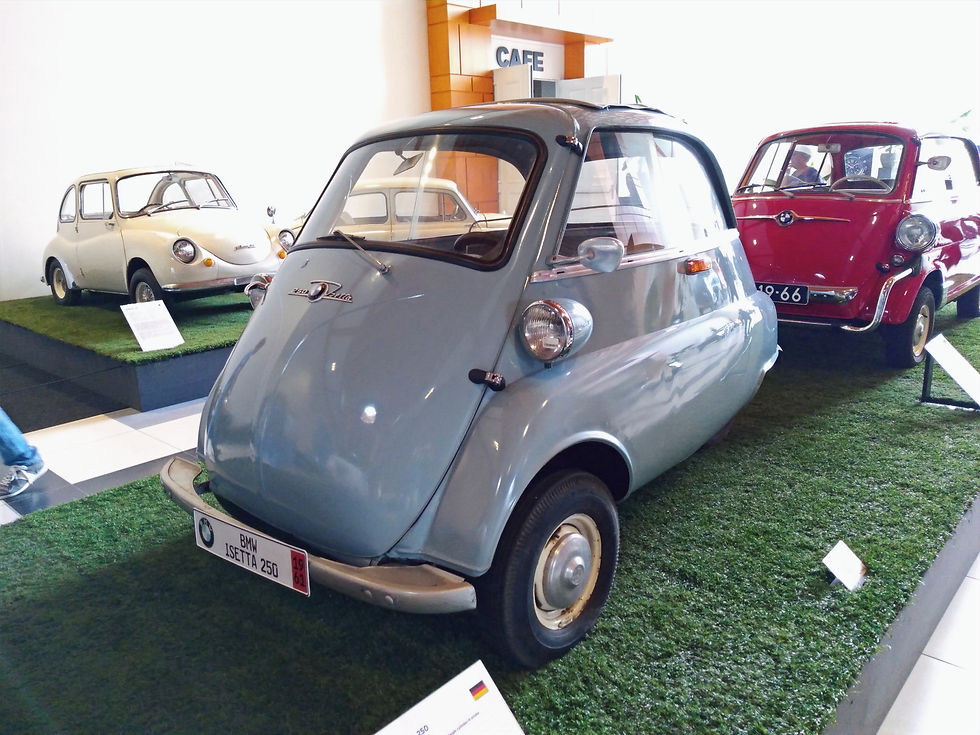

The countries with the greatest variety of makes represented were Great Britain and Germany. Among the British makes on display were the Allard Clipper, AC Petite, Bond Minicar, Frisky Family Three, Opperman Union, Peel P50 and Coronet. Germany, which at the time was divided into two blocs separated by the Berlin Wall, was represented by makes from both sides. From West Germany came the original Messerschmitt KR 175, the Fuldamobil mentioned above, and other models such as the Heinkel Kabine 154, the Maico 500, the Goggomobil TS-250 and the coupé version of the model that was also manufactured under licence in the Basque Country. The exhibition also featured two BMWs with front-hinged doors: the Isetta 250, derived from the original Italian model, and the 600, its extended version with seating for four. The former East Germany, meanwhile, was represented by an IFA P70.
From Czechoslovakia, also part of the former Eastern Bloc, came a curious Velorex Oskar 16, featuring a tubular frame covered in vinyl tarpaulin and powered by a Jawa engine. It was perhaps the vehicle in the exhibition that most closely resembled a motorbike.
France was represented by a tiny Rolux Baby, reminiscent of a child's scale-model car and featuring bodywork inspired by the 1930s, as well as two Italian-designed models: the Velam Isetta and the Vespa 400.

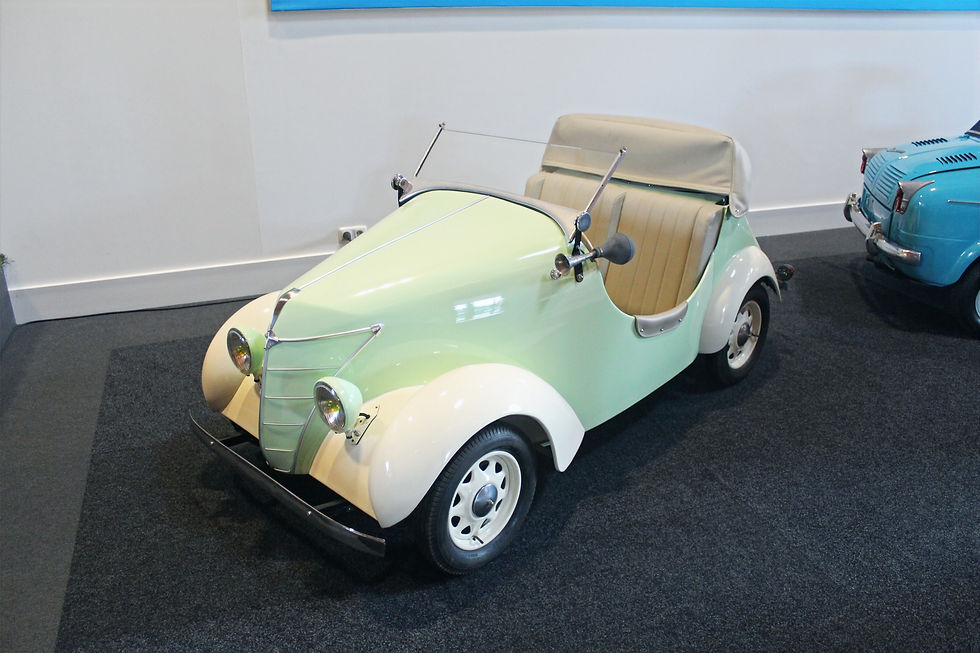
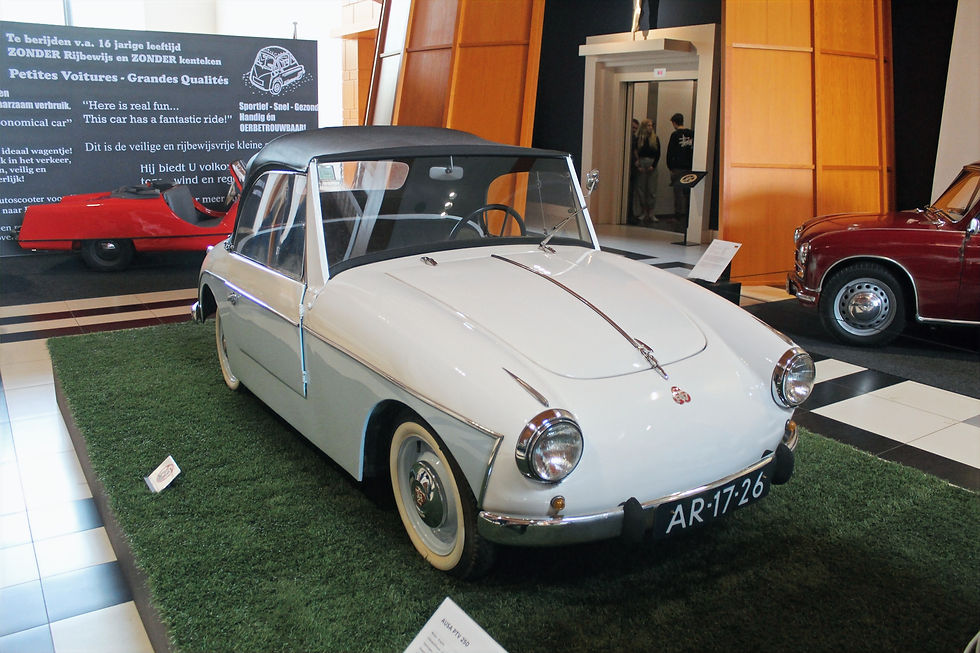
Finally, three microcars manufactured in Barcelona were displayed in the centre of the room. An early version of the Biscuter, which still lacked a reverse gear, and a JFC Delfín microvan shared the same Hispano Villers single-cylinder engine, as did so many other Spanish two- and four-wheeled vehicles of the era. Next to them stood a PTV 250, manufactured by AUSA, a company based in Manresa that continues to produce vehicles today. With its elegant open-top bodywork, the PTV stood out from the rest of domestic production, most of which relied on engines manufactured under licence, as it featured an engine of its own design.

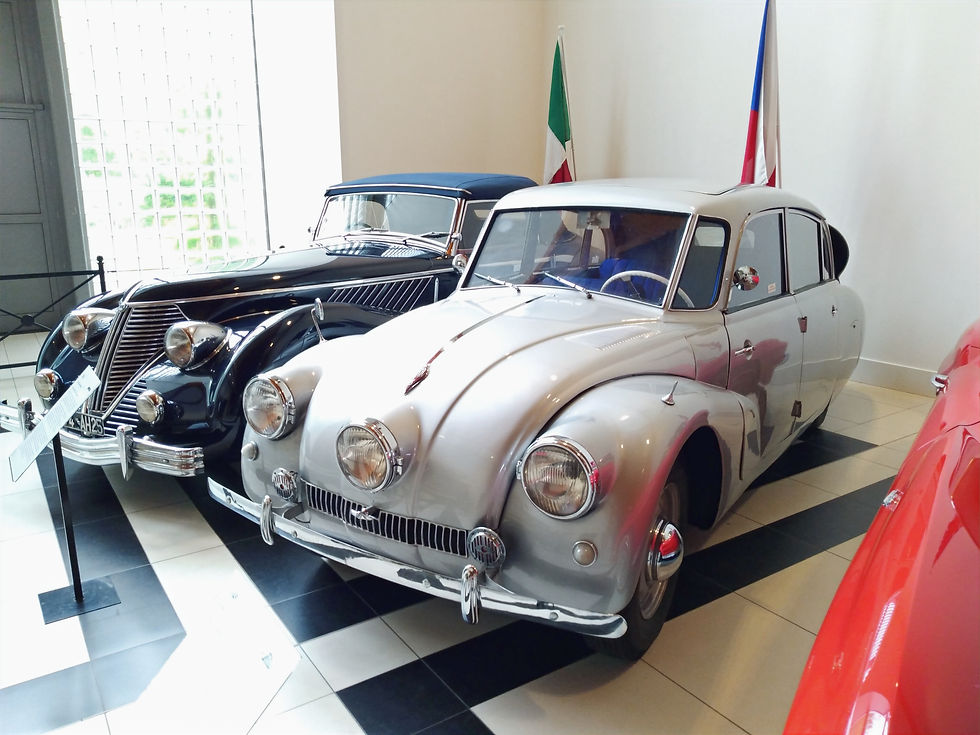
Sharing the exhibition space with the microcars were other automotive marvels. One highlight was a magnificent Lancia Astura with a three-litre V8 engine. Designed by Battista ‘Pinin’ Farina, this model was chosen by Mussolini as the official vehicle of his government. Next to the Astura stood another gem: the Tatra T87, in considerably better condition than the example at the Lomakov Museum in Moscow, which can be seen in the blog post dedicated to this model.
It was a pleasant coincidence that my visit to the Louwman Museum coincided with the microcar exhibition. Cycling there from Delft or The Hague is always a pleasure, but on this occasion, the reward was twofold.
You may also read this post in Catalan and Spanish


Comentaris