


Biscuter Commercial Van
Actualitzat: 1 day ago
The Biscuter was the most widely produced and popular Spanish microcar. It is difficult to establish exactly how many were built between 1953 and 1960, but the most reliable estimates put total production at around 12,000 units. A symbol of the hardships of post-war Spain, it was born out of the ingenuity of Gabriel Voisin, one of France's great engineers, who had made his name building aircraft engines and luxury cars before the Second World War.

Powered by a 197cc Hispano Villiers single-cylinder, two-stroke engine, the Biscuter became an affordable means of transport for those who could afford something more than a motorcycle but could not stretch to a conventional car.
The early versions, which had no reverse gear and were started by means of a hand lever, gradually evolved into several different models. The 200F, known as the Pegasín, was something of a luxury Biscuter, with a fibreglass body inspired by the competition Pegaso models. Both this version and the commercial (200C) and industrial (200I) variants arrived on the market when the marque's decline was already difficult to halt, particularly with the arrival of cars such as the SEAT 600.

The commercial and industrial versions are sometimes confused, as both featured wooden panels at the rear. The commercial model, popularly known as the Rubia, retained a uniform body height along its entire length. The industrial version, on the other hand, had a raised load compartment, wider than the front section, with a corrugated metal roof reminiscent of the early Citroën 2CV vans.

In 1958, the Biscuter Pegasín cost almost as much as a SEAT 600. Given that the two cars were in entirely different leagues in terms of carrying capacity, performance, build quality, safety and reliability, it is hardly surprising that the Biscuter, like the other Spanish microcars, soon disappeared from the country's roads.
A Wallapop advert offering several Moto Guzzi 65s led me to a property outside Valencia, where dozens of motorcycles from the 1950s, 1960s and 1970s were piled up. Outside, there were also the remains of a SEAT 1200 Sport, virtually stripped beyond recognition and with little chance of being saved.

Inside a building that had once been a rice mill, even more motorcycles and all sorts of odds and ends were piled up. Amongst this jumble stood a Biscuter 200 I, the van version introduced in 1958, by which time the marque's decline was already unstoppable.

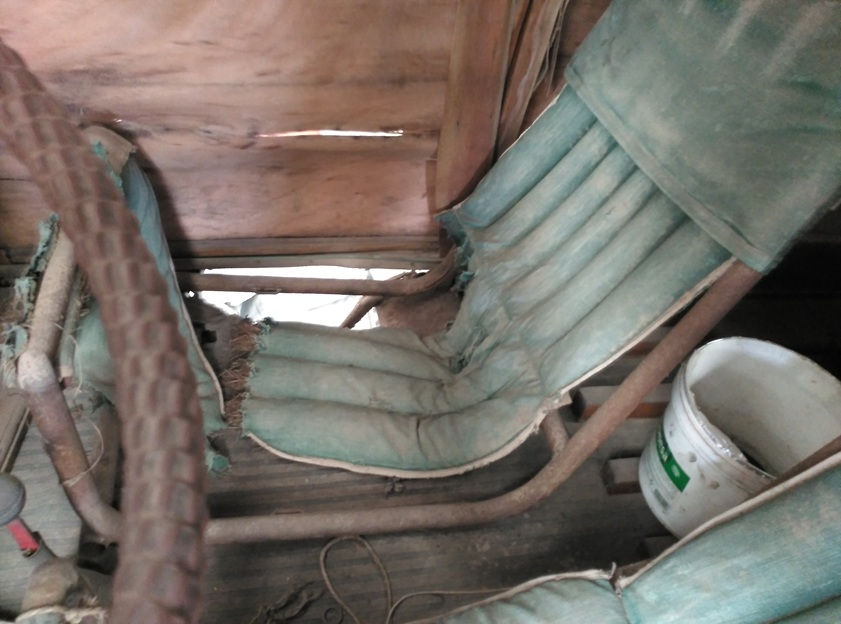
Although it looked rather sorry for itself at first glance, it was actually quite complete. The original mechanical components were still there, and only the wooden door panels and load-compartment sides appeared beyond repair. In the engine bay, the unusually large cylinder head designed by Voisin was still in place, reflecting the influence of his earlier aircraft-engine designs.
One detail that particularly caught my eye was the old Spanish roadworthiness-test sticker still attached to the windscreen. This suggests that the vehicle had remained road-registered and in use until sometime around the 1990s.

Amongst the stories told by the owner was a particularly curious one: during the 1960s, the van had belonged to a butcher. A few hooks for hanging meat could still be seen inside the load compartment. According to the owner, during those years of hardship, the meat was often marsh rat, which was considered quite a delicacy at the time.
It is a real shame to see this Biscuter in its present condition. Despite the difficulties and expense involved in restoring it, I am sure there would be more than one enthusiast willing to bring it back to life and see it running once again among the rice fields.


