


BMW Museum in Munich
Museums of major brands are usually a delight for car enthusiasts. BMW's museum is no exception, so a visit to Munich is a great opportunity to explore the brand's history. You can also take a tour of the assembly lines of the latest models.

BMW's history dates back to the early 20th century. After World War I, Germany was subject to sanctions that prevented BMW from continuing to manufacture aircraft engines, which had been its main activity. The leap to automobile production occurred in 1928 when it acquired Fahrzeugfabrik Eisenach, owner of the Wartburg brand. The Eisenach plant was then producing the Dixi, a small car derived from the Austin Seven, which was manufactured under license. Therefore, the BMW Dixi was the first BMW with four wheels. The BMW 3/15 from 1930 in the museum is an evolution of the Dixi. This time it is in a technical assistance van version.

Within a few years, the brand had gone from manufacturing licensed models to setting the technological benchmark. The 1936 BMW 328 played a significant role in this development. This small convertible with a 6-cylinder, 2-litre engine and 80 HP became a cornerstone, achieving sporting successes such as winning its category in the 1940 Mille Miglia. The model stood out not only technically, but also for the beauty of its lines, which made its body one of the most imitated in the replica industry.

World War II was the most shameful period in BMW's history. The company was complicit in the Nazi regime's crimes, exploiting tens of thousands of forced labourers, prisoners of war and concentration camp inmates. After the war, the Eisenach factory fell into Soviet hands, and production resumed using the Bavarian brand, which was later converted into EMW. You can read the history of that brand in the following post. The BMW 327 pictured is one of the models that BMW manufactured before and after the war, and which ended up being among the first EMWs on the other side of the Iron Curtain.

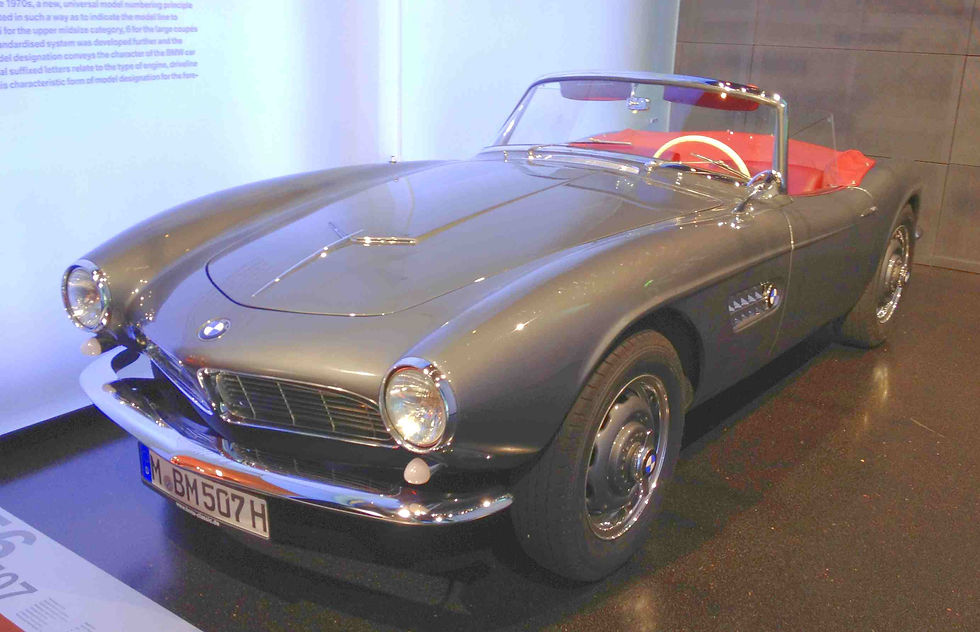
The period of hardship that followed the war made it difficult to launch new products. Most of the population was struggling to survive. BMW was limited to resuming production of pre-war models. However, by the mid-1950s, the situation had improved and the rivalry with Mercedes prompted the Bavarian brand to develop the BMW 507 to compete with the 300SL. This roadster, which is considered one of the most beautiful cars in history, uses a shortened version of the 503 platform and is equipped with a 3200cc V8 engine and an aluminium body. Unfortunately, the high development and manufacturing costs meant that it was beyond the budget of most customers. Only 254 were produced, putting the company on the verge of bankrupcy. One of the most famous units was owned by Elvis Presley. The video of the restoration of this car that is circulating on the internet is particularly interesting.
In such a delicate situation, the success of the BMW 250 proved to be a lifeline for the company. Based on the Iso Isetta with its distinctive front door, this microcar is one of the most popular models, known beyond the circles of enthusiasts. Unlike the Italian model, the BMW version had a four-stroke, single-cylinder engine derived from their motorcycles. An interesting development of the Isetta was the BMW 600, which kept the front door and lengthened the body to add rear doors and turn it into a four-seater. I couldn't see any units of that interesting model, also assembled in Argentina, in the museum, but I did see a BMW 700 with a more conventional body. These three small models helped the company to overcome one of its most challenging periods until the arrival of the Neue Klasse in the early 1960s, of which the BMW 2002 is a notable example.


In the late 1960s, the launch of the E9 series confirmed the brand's recovery following the post-war period. Derived from the 2.0 CS with its four cylinders and unconventional front, the Neu Sechs was born in 1968 with a double-headlight front and black horizontal grille that would become the brand's trademark for decades. The six-cylinder 2.8-litre and 3.0-litre engines eventually incorporated electronic injection and reached their peak with the BMW 3.0 CSL. This lightweight version, which shed 200 kg to excel on the racetrack, was a huge success. Nicknamed the 'Batmobile' due to its aggressive look full of spoilers, air intakes and wings, the CSL left car enthusiasts speechless.

The museum houses not only production models, but also racing cars and show prototypes. One of the most attractive cars is the 1972 BMW Turbo. Designed by Paul Bracq to commemorate the Olympic Games of that year, it is a real head-turner. The museum's model is one of only two produced. With its gull-wing doors and distinctive wedge shape, the car represented a significant departure from the brand's previous aesthetic, influencing design until the launch of the 8 Series in 1989.


One of the designs most directly influenced by the 1972 Turbo was the BMW M1. The M1 was initially conceived for competition and designed by Giorgietto Giugiaro. However, homologation requirements demanded the production of a number of units that the brand's competition department could not meet, so they resorted to Lamborghini. The Italian manufacturer's difficulties soon led Motorsport to resume management of the project. Although the sports and commercial plans for the M1 were never realised, at least we were left with a beautiful sports car.

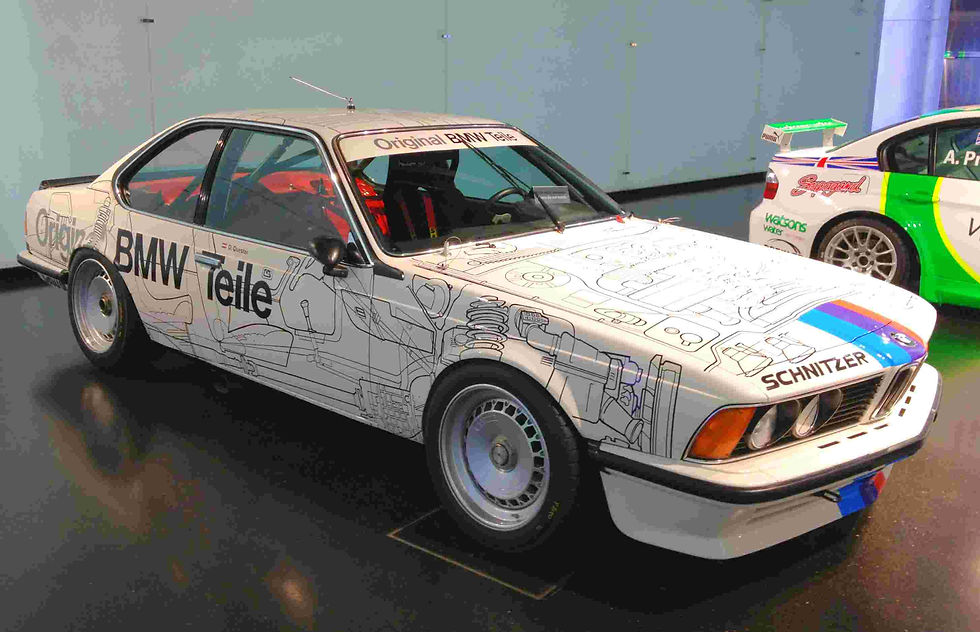
Anyone of a certain age will remember the BMW 6 Series as one of the most desirable coupes of the 1970s and 1980s. This unit is one of just 50 BMW 635 CSI Group A cars prepared by Schnitzer for racing on European circuits. With more than 300 horsepower under the bonnet. It achieved significant success from 1982 onwards. Its discreet design, free of exaggerated spoilers and wings, and with that elegance so close to the series, seems especially attractive to me with this decoration featuring a white background and an X-ray of its internal organs.
Here are some of the most outstanding models that can be enjoyed in the museum. If you are a classic cars enthusiast and are near Munich, a visit to the museum is a must.


Comentarios